
Sagemcom Odit-e
Odit-e digitizes electricity distribution networks to support the energy transition.
Low Voltage: The new frontier
of the energy transition
Public LV (Low Voltage) distribution networks are neither monitored nor remotely controlled.
Reinforcement and modernization planning is based on the assumed wear of equipment, theoretical load curves, and basic tools, involving large safety coefficients, and therefore often far from actual field conditions.
Yet, Low Voltage network infrastructures represent 70% of fixed assets and generate 50% of operating costs.
Why Sagemcom Odit-e?
The new challenges of electricity
distribution networks
Networks in Transition
Accelerating and making the energy transition viable in industrialized countries.
Photovoltaics
Photovoltaics
EV charging stations
EV charging stations
€400 billion
Invested in European networks by 2030
20 %
Renewable energy deployment limit
30 %
Avoidable investments
70 %
Of PV production installed on LV networks
Developing Networks
Contributing à l’atteinte de l’ODD #7 de l’ONU dans les pays en développement
700 million
People living in urban areas, where electrical infrastructures suffer
from highly unbalanced voltage plans and high costs
for productive needs such as cold chains, rotating machines, etc.
A unique opportunity:
Smart meter rollout
For the first time in history, the mass deployment of smart meters gives
operators a large-scale observation tool for LV networks..
With millions of data points collected daily, new opportunities emerge. Sagemcom Odit-e leverages this data
by offering services tailored to the specific challenges of network operators..
150 million
Smart meters in Africa by 2030
300 million
Smart meters in Europe by 2030

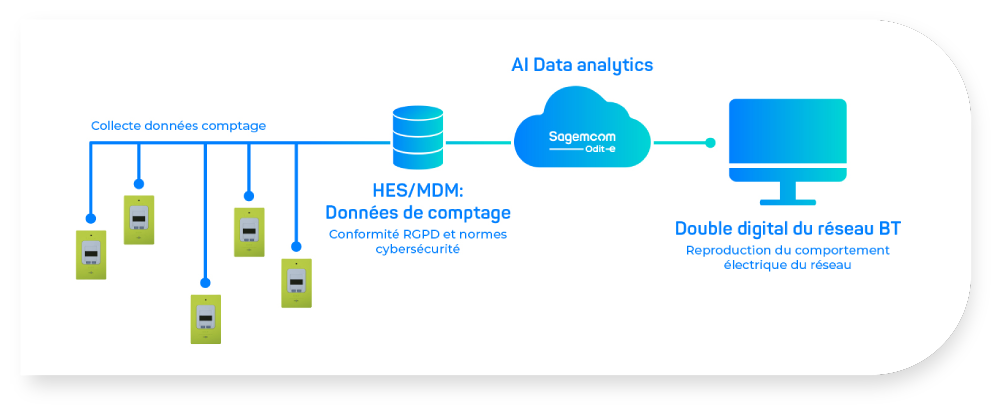
LV Network Digitalization with Sagemcom Odit-e
Today, most smart meter data is used solely for billing. Sagemcom Odit-e goes further by building a digital twin of the LV grid, capable of reproducing its electrical behavior accurately and reliably. This model is powered by AI constrained by physical laws , forming the foundation of all Odit-e services.
More